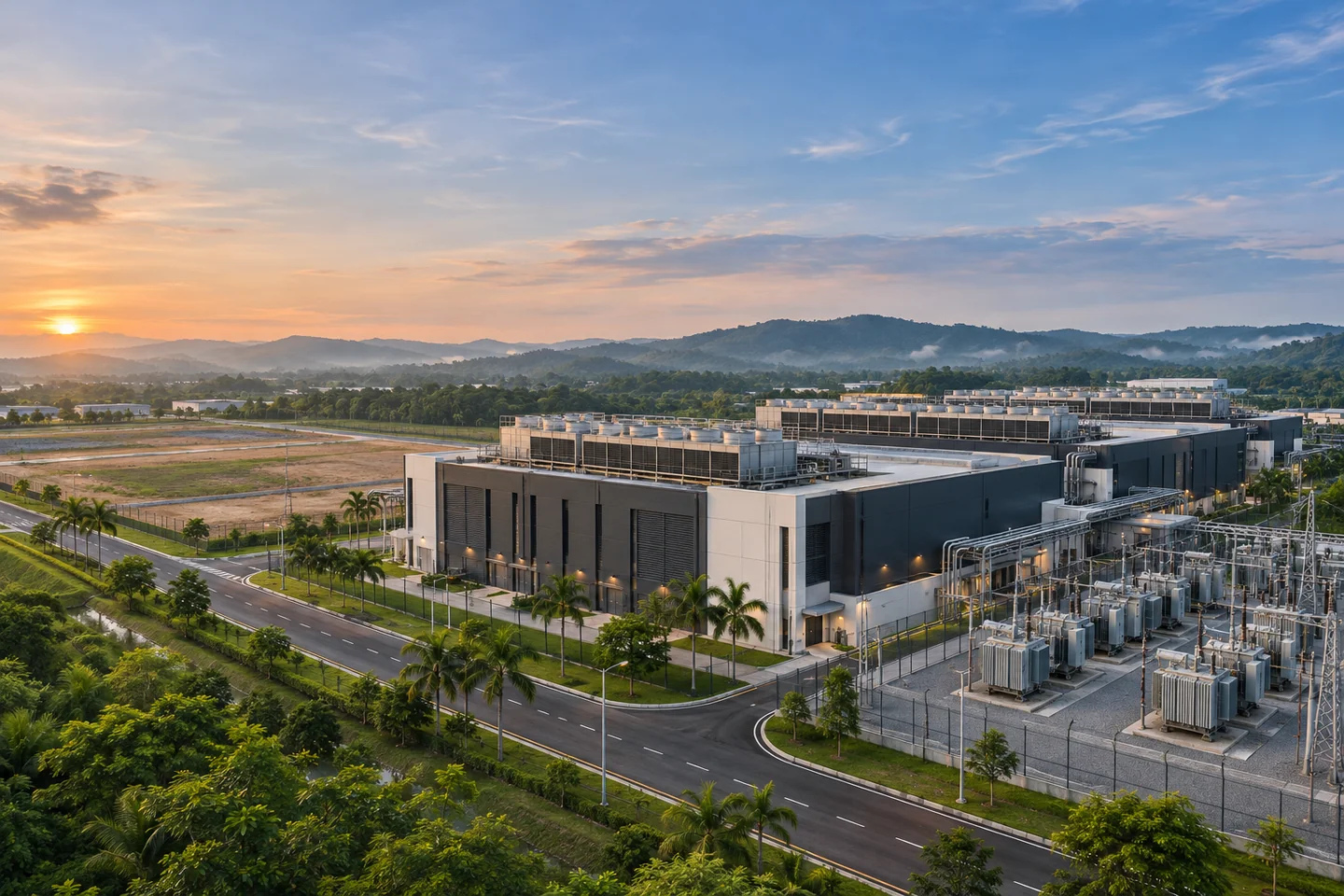
The Financial Times reported on 26 November that NVIDIA told manufacturing partners, including Dell and Supermicro, to pause shipments of servers containing NVIDIA chips to Malaysia, Singapore, Thailand and Indonesia. The duration was unclear. For Malaysian data centre landowners, verify the buyer’s hardware and funding before committing to long exclusivity, a fixed closing date or project-specific grid works.
Read the original Financial Times report Read the report on CNA
Already preparing a land search? Send your private data centre requirements brief ↘
1. What the shipment pause means for data centre land
The reported shipment pause follows new U.S. Bureau of Industry and Security (BIS) rules that took effect on 19 November 2026. The rules add destination-based licensing for certain advanced computing items going to the four Southeast Asian markets and Brazil. Separate end-use controls address significant remote access to advanced computing for certain companies based in China, Macau and other designated destinations or with ultimate parents based there.
The impact on a land deal depends on when the operator needs the equipment. A developer may already have paid for grid studies, design or site preparation by the time a tenant’s server delivery slips. A project with an independent ability to fund and operate its initial phase has more room to adjust its programme.
- Project finance. Specialist cloud providers that rent out AI computing power can face extra scrutiny when lenders cannot verify chip deliveries or customer eligibility. The Financial Times reported one financing interruption linked to a Singapore-based cloud project. Fitch Ratings expects tighter financing for projects with uncertain chip supplies or customer eligibility.
- Power commitments. Identify which party has signed the electricity supply agreement, which grid works have been committed and what happens if the tenant misses the planned load ramp. Confirm plot-specific capacity and dates with Tenaga Nasional Berhad (TNB) or the relevant utility.
- Demand by workload. AI facilities dependent on new deliveries of covered servers face direct procurement exposure. Enterprise hosting, storage, edge and colocation projects can have different equipment requirements. Ask for the hardware and power brief before pricing the risk.
Sources: Reuters · U.S. Bureau of Industry and Security · Financial Times via CNA · Reuters · Tenaga Nasional Berhad
2. Which operators and developers have less exposure?
U.S.-headquartered hyperscalers can have a clearer route for covered shipments. The new destination-based requirement has an exclusion for eligible ultimate consignees or end users headquartered in the U.S., or with an ultimate parent headquartered there, provided the exporter, reexporter or transferor meets BIS reporting requirements. Check the legal entity taking delivery and the intended use. Separate end-use and end-user controls may still apply, and the supplier must confirm its delivery plan.
- Domestic enterprise and telecom operators serving banking, government or retail customers may have easier-to-document workloads and customer relationships. Their exposure depends on the hardware they need, the end user and the intended use.
- Diversified industrial parks can keep pursuing tenants in advanced manufacturing, logistics and conventional enterprise computing. Actual tenant demand and fit with the park’s utility and planning conditions determine whether these uses can support an individual parcel.
Sources: U.S. Bureau of Industry and Security · Reuters
3. Where land negotiations are likely to tighten
Buyers negotiating a sale and purchase agreement (SPA), long lease or joint venture may seek extra time or a lower price to absorb procurement and compliance costs. A landowner can price extensions and tie them to milestones. Whether a price adjustment is justified depends on the parcel, competing demand and who carries the cost if closing slips.
Ask for the purchasing entity, a credible supplier delivery estimate, the approval pathway where applicable and proof of funding before granting lengthy exclusivity. Check what the lender must see before disbursing and whether the buyer can fund the land and grid costs independently of the server order.
| Stage | What to settle |
|---|---|
| Due diligence and exclusivity | Identify the buyer, tenant and intended hardware recipient. Define the review period, extension fees and evidence required to extend it. |
| Conditional SPA or lease | Specify which approvals apply, who obtains them, what evidence satisfies each condition and who pays if utility or design work starts before closing. |
| Funding and long-stop date | Document committed equity, lender disbursement conditions and when either side can exit. Agree how deposits and sunk costs are treated. |
| Closing and development | Set closing and possession against the agreed milestones. Schedule construction and utility works around the verified delivery programme. |
Sources: Reuters
4. How landowners can manage the risk
Keep the land and power strategy workable if a single tenant’s shipment is delayed. Document which commitments are already binding and which can be made in stages with the relevant parties.
| Action area | What to do |
|---|---|
| Tenant mix | Shortlist operators with documented end users, diversified customers and a workable hardware plan. Keep suitable enterprise, telecom and manufacturing enquiries active while the first deal is conditional. |
| Phased power | Ask the utility about feasible MW tranches, energisation milestones, charges and potential reassignment. Confirm any change in writing before assuming that capacity can be redirected to another user. |
| Contract protections | Have advisers define end-user and intended-use representations, approval and reporting milestones where applicable, change notifications, deposit treatment and the right to exit on a missed long-stop date. |
| Master planning | Test alternate uses such as advanced packaging or precision engineering against land title, zoning, planning permissions, utility design and access. Protect layouts that can serve credible alternatives. |
Sources: Tenaga Nasional Berhad · U.S. Bureau of Industry and Security
5. Malaysia compared with other regional markets
MIDA recorded RM123.5 billion in approved data centre and cloud computing investments across 86 projects in the first nine months of 2026, an increase of 44.5% year on year. The figure measures approvals. It illustrates the existing pipeline, while each project still needs to secure its own financing, equipment and connections.
Johor and the Cyberjaya–Klang Valley corridor offer established data centre ecosystems. MIDA identifies Nexus Sedenak in Johor and the existing digital ecosystem in Cyberjaya and the Klang Valley. For buyers comparing sites, the practical differentiators are the contractual power-on date, approved water and cooling arrangements, documented fibre routes, and a tenant’s ability to procure equipment.
Singapore, Thailand and Indonesia are also covered by the reported pause. Fitch expects capital to favour projects with secure chip access and diversified customers across the region. A Malaysian site with those conditions can compete for investment, while a hardware-dependent project with exposed customers can face more scrutiny even in an established park.
Sources: Malaysian Investment Development Authority · Reuters · Reuters
6. What developers should watch next
Malaysia’s Ministry of Investment, Trade and Industry (MITI) said on 18 November that it was seeking clarification from U.S. authorities on licensing and third-party data centre services. For landowners, a written change in the vendor’s delivery date, the lender’s funding conditions or the utility’s milestones is more actionable than a regional prediction.
- BIS and hardware suppliers. Track published licensing and reporting guidance and obtain a project-specific delivery statement from the supplier. The rule’s 90-day provision concerns certain existing remote-compute arrangements.
- Equity and lenders. Verify capital commitments and drawdown conditions before extending exclusivity or bringing forward site and utility costs.
- Local delivery. Check for MITI updates and ask TNB or the relevant local utility to confirm any change in supply dates, phased capacity or reservation terms for the plot.
Sources: U.S. Bureau of Industry and Security · Bernama · Tenaga Nasional Berhad
Common questions.
What is the scope of the reported NVIDIA pause in Malaysia?
The Financial Times reported that manufacturing partners including Dell and Supermicro told buyers in Malaysia, Singapore, Thailand and Indonesia that affected orders for servers containing NVIDIA chips could not ship. The report did not establish when shipments would resume.
Can a U.S.-headquartered hyperscaler qualify for a licensing exclusion?
A qualifying U.S.-headquartered ultimate consignee or end user, or an eligible entity with a U.S.-headquartered ultimate parent, can fall outside the rule’s new destination-based licensing requirement if the relevant party complies with BIS reporting. Separate controls can still apply.
Can a landowner reassign unused data centre power capacity?
Reassignment depends on the utility’s approval, the existing agreement and the engineering requirements of the new user. Ask the utility whether the allocation can be staged, amended or transferred before relying on it.
Sources & further reading.
- Original reporting on the NVIDIA shipment pause, 26 November 2026 Financial Times · Accessed 27 November 2026
- NVIDIA server shipment pause reported in four Southeast Asian countries, 26 November 2026 Reuters · Accessed 27 November 2026
- Addressing Remote Access to Advanced Semiconductors, 91 FR 74970 U.S. Bureau of Industry and Security · Accessed 27 November 2026
- Shipment pause and reported financing interruption at a Singapore-based project Financial Times via CNA · Accessed 27 November 2026
- Fitch Ratings outlook on project finance and investment following U.S. chip curbs Reuters · Accessed 27 November 2026
- Approved investments in Malaysia in the first nine months of 2026 Malaysian Investment Development Authority · Accessed 27 November 2026
- Malaysia seeks clarification on U.S. AI chip restrictions, 18 November 2026 Bernama · Accessed 27 November 2026
- Electricity Supply Application Handbook Tenaga Nasional Berhad · Accessed 27 November 2026